
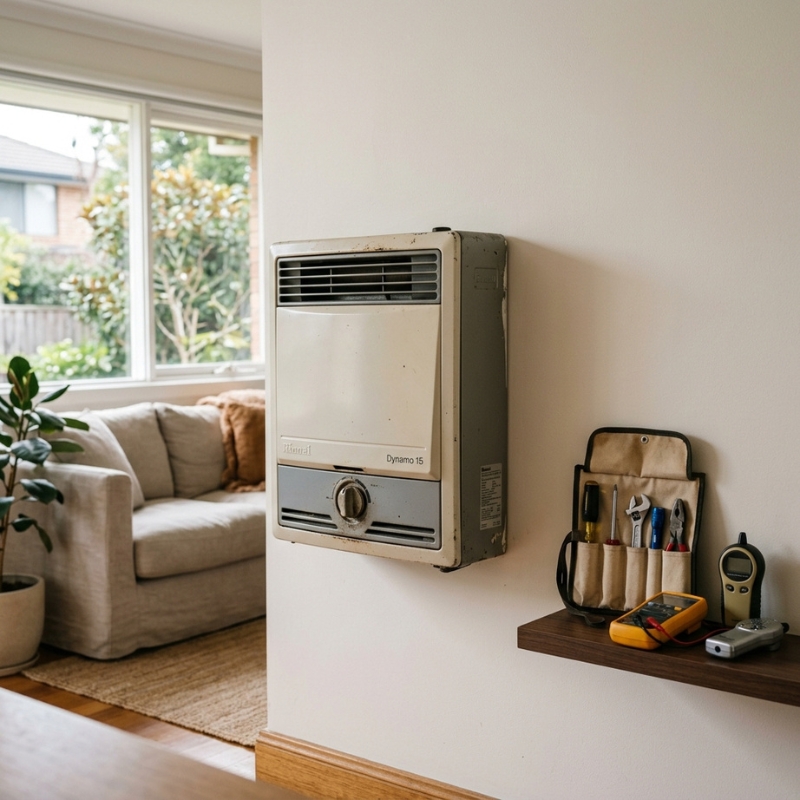
When your gas heater keeps playing up, you face a familiar dilemma: do you keep paying to repair it, or bite the bullet and replace it? Spend too much fixing an old unit, and you throw good money after bad; replace too soon, and you spend on a new heater you did not need. At Apex Gas Heater Service, we assess and repair gas heaters across Sydney, and we would rather help you make the right call than push you toward a new unit. This guide gives you a clear framework to decide, based on age, cost, safety and common sense.
| Quick answer
As a rule of thumb, repair your gas heater if it is under about 10 to 12 years old, the fault is minor, and the repair costs less than roughly half the price of a replacement. Consider replacing it if it is older, unsafe, failing carbon monoxide checks, or needs repeated costly repairs. A licensed gas fitter can advise after a safety inspection. |
How long does a gas heater last?
Most gas heaters have a working life of somewhere around 10 to 15 years, though it varies with the type, the brand and how well the heater has been maintained. A well-serviced unit at the lower end of its age is usually worth repairing, while one pushing past 15 years is closer to the end of its dependable life. Space heaters, wall furnaces and ducted systems all age a little differently, and a heater that has had annual servicing generally lasts longer and stays safer than one that has been ignored. Age alone does not force a replacement, but it does shift the odds, and it is the first thing to weigh when a repair bill lands. As a heater ages, parts also become harder to source, which can turn a simple repair into a longer wait or a dead end. It is also worth keeping your service records, as a documented history helps a gas fitter judge whether a repair is a sound investment.
6 signs your gas heater should be repaired (not replaced)
Plenty of faults are worth fixing, especially on a heater that still has years left in it. Lean toward repair when:
- The heater is under about 10 years old and has been serviced regularly.
- The fault is a single, identifiable part such as an igniter, thermostat or fan.
- The repair cost is well under half the price of a comparable new unit.
- It otherwise passes its safety and carbon monoxide checks.
- Parts for your model are still readily available.
- It has been reliable until now, and this is a one-off breakdown.
If most of these apply, a repair is usually the sensible, cost-effective choice, and it keeps a good heater doing its job for several more winters.
6 signs it’s time to replace your gas heater
Sometimes replacement is the smarter money, and occasionally it is the only safe option. Consider a new heater when:
- The unit is about 12 to 15 years old, and faults are becoming regular.
- It has failed a carbon monoxide test or shows signs of unsafe combustion.
- The heat exchanger is cracked or damaged, which is a serious safety issue.
- Parts are obsolete or no longer available for your model.
- Repair costs are creeping toward half the price of a new heater, or beyond.
- Running costs are climbing as the ageing unit loses efficiency.
When several of these stack up, repairs stop making financial sense, and a modern, efficient heater usually pays you back in reliability and lower running costs.
The 50% rule and running-cost maths
A simple heuristic keeps the decision honest: if a repair costs more than about half the price of replacing the heater, replacement is usually the better value, especially on an older unit. It is not a hard law, but it stops you from sinking repeated large bills into a heater near the end of its life. Factor in running costs too. An old, inefficient heater quietly costs more to run every winter, so a cheaper-to-run replacement can offset part of its price over time. The catch is that you need an accurate repair quote and an honest assessment of the heater’s condition to do the maths, which is exactly what a licensed gas fitter provides. If you are weighing it up, you can book a gas heater repair and ask for an assessment at the same time, so you have real numbers rather than guesses. Put simply, protect a young, healthy heater, and be willing to let go of an old, tired one.
Safety first: when replacement is non-negotiable
Cost aside, some situations mean a heater has to go regardless of its age. A cracked heat exchanger, a unit that repeatedly fails carbon monoxide checks, or a heater a gas fitter has deemed unsafe should never be patched up and kept running. Carbon monoxide is colourless and odourless, and a heater that is not burning safely can put your household at real risk. If you are not sure what to watch for, our guide to carbon monoxide warning signs explains the symptoms and red flags to take seriously. When safety is the issue, replacement is not a choice between saving money and spending it, it is simply the right thing to do.
Frequently asked questions
Is it worth repairing a 15-year-old gas heater?
Often it is not the best value. At around 15 years, a heater is near the end of its typical life; parts can be hard to find, and further faults are likely. A minor, cheap fix might buy another season, but if the repair is major or safety is in question, replacement usually makes more sense.
How much does it cost to replace a gas heater in Sydney?
It varies widely with the type of heater, whether it is a single unit or a ducted system, and the installation required, so there is no single price. The reliable way to budget is to have a licensed gas fitter assess your setup and provide a quote for a suitable replacement.
What’s the average lifespan of a gas heater?
Most gas heaters last somewhere around 10 to 15 years, depending on the type, the brand and how well they have been maintained. Regular annual servicing tends to extend that life and keep the heater running safely, while a neglected unit often needs replacing sooner.
Can a gas heater be dangerous if it’s old?
Yes. As heaters age, components wear, and the risk of unsafe combustion and carbon monoxide rises, particularly if the unit has not been serviced. An old heater is not automatically dangerous, but it should be checked by a licensed gas fitter, who can confirm whether it is still safe to use.
Final thoughts
Repair or replace does not have to be a guess. Weigh the heater’s age, the cost of the fix against a new unit, and above all its safety, and the right answer usually becomes clear. When in doubt, get a professional opinion before you spend either way. You can book a gas heater repair or a safety inspection with Apex Gas Heater Service, and we will give you an honest assessment so you can decide with confidence.
| Ready to book?
Not sure whether to repair or replace? Apex Gas Heater Service can assess your heater across Sydney. Book a repair or safety inspection for an honest recommendation. |