
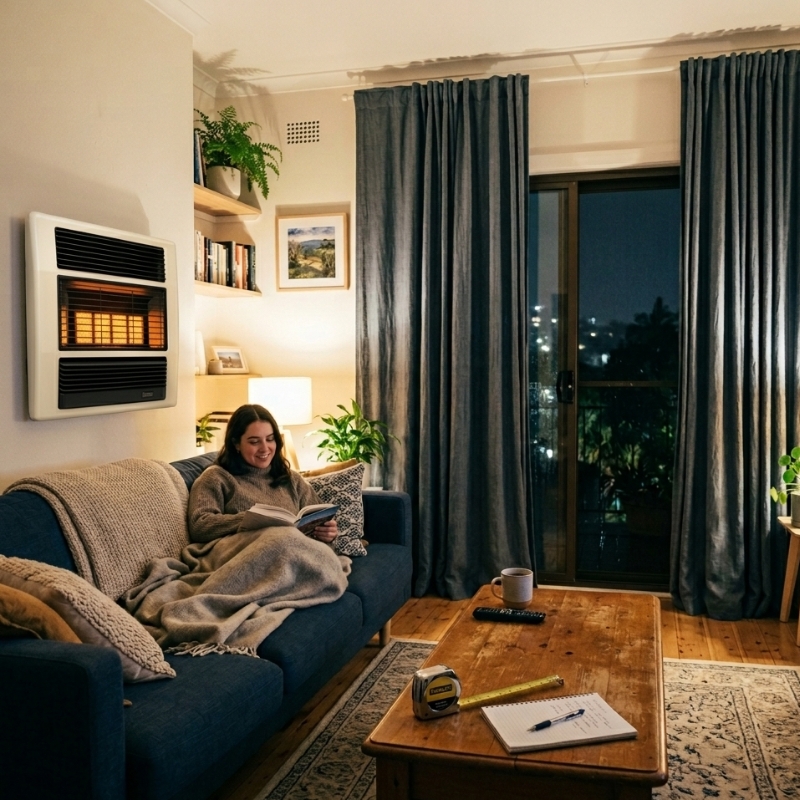
Choosing a gas heater sounds simple until you start comparing models and thinking ahead to gas heater installation. Suddenly you’re staring at kW ratings, “small/medium/large room” claims, and advice that swings between “bigger is better” and “don’t oversize.”
In Sydney, sizing mistakes are common because our winter is relatively mild, but our housing is anything but consistent. You might be heating a draughty terrace living room one night, then an apartment with a wall of glass the next. Open-plan layouts, high ceilings, and leaky windows can make a “perfectly reasonable” heater feel underpowered.
This guide gives you a practical way to estimate the right size for your room, then adjust for the real-world factors that actually change comfort and running performance. You’ll also learn the signs you’ve chosen the wrong size (too small or too big), and when it’s worth getting a licensed professional to sanity-check the situation.
What “size” really means for a gas heater
When people say “size,” they usually mean heat output — the heater’s ability to put warmth into a room at a rate that keeps up with heat loss.
A few things to keep in mind before you calculate anything:
- A room doesn’t just need to warm up — it needs to stay warm. That’s where sizing matters most.
• Heat loss is the enemy. Drafts, glass, and open-plan connections can double the heating demand.
• Control matters. A well-controlled heater that matches your space often feels more comfortable than a bigger unit that blasts on and off.
Q&A: Is “larger” always more comfortable?
Not necessarily. Oversized heaters can heat the room fast, then cycle on and off, which can create temperature swings and a “hot then cool” feeling. Right-sized heating is usually steadier and more pleasant.
Two sizing methods that actually work
You’ll see lots of rules of thumb online. The most useful approach is to start with a baseline estimate, then adjust for your home’s reality.
Method 1: Size by floor area (m²) for a quick estimate
If you want a fast starting point, sizing by square metres is the simplest.
A practical baseline for many Sydney rooms is:
• 0.10 kW per m² for reasonably insulated rooms with standard ceilings
• 0.12–0.15 kW per m² for older, draughtier rooms, lots of glass, or open-plan areas
Example
A living room that’s 25 m²:
• Baseline: 25 × 0.10 = 2.5 kW
• Drafty / lots of glass: 25 × 0.13 = 3.25 kW
This method is quick, but it assumes average ceiling height and average insulation. If either of those assumptions is wrong, Method 2 will be more accurate.
Method 2: Size by room volume (m³) for better accuracy
Room volume accounts for ceiling height — and ceiling height matters because you’re heating air, not floorboards.
Step 1: Measure the room
• Length × width × ceiling height = volume (m³)
(For odd shapes, break the space into rectangles, calculate each, then add them.)
Step 2: Apply a heat factor
For Sydney, a practical range is:
• 0.04 kW per m³ for well-sealed, insulated rooms
• 0.05–0.06 kW per m³ for average rooms
• 0.07 kW+ per m³ for very draughty rooms, lots of glass, or exposed areas
Example
A 5 m × 4 m room with a 2.7 m ceiling:
• Volume = 5 × 4 × 2.7 = 54 m³
• Average room: 54 × 0.05 = 2.7 kW
• Draughty / lots of glass: 54 × 0.07 = 3.78 kW
Quick answer
If you want one practical method:
• Use m² sizing as a starting point for standard rooms
• Use m³ sizing for high ceilings, open-plan spaces, and lots of glass
• Then adjust based on the factors below (drafts, insulation, windows, layout)
Q&A: Should I size by m² or m³ if I’m unsure?
If you have standard ceilings (around 2.4–2.7 m) and a closed room, m² will usually get you close. If the space is open or the ceilings are high, m³ is safer.
kW explained in plain English (and a common comparison trap)
kW is a measure of heat output — how much heat the appliance can deliver.
Two practical tips when comparing models:
• Look for the figure that reflects heat delivered to the space (heat output), not just marketing descriptions.
• If you’re comparing across different heater types or product categories, double-check you’re comparing like-for-like numbers.
Q&A: Why do different sources recommend different kW figures?
Because the “right” kW depends heavily on heat loss. Two rooms can both be 20 m², but if one is a sealed bedroom and the other is a glassy open-plan space, their heating demand can be worlds apart.
The 6 real-world factors that change heater size the most
Think of your calculated kW as a starting point. These factors decide whether you stick close to it or size up.
1) Ceiling height
Warm air rises. Higher ceilings create more volume and often more heat loss — especially in older homes with gaps and limited insulation.
Practical guidance:
• If your ceiling is above 2.7 m, favour volume sizing
• Raked ceilings and voids can push demand up quickly
• Ceiling fans on low (winter mode) can improve comfort by mixing air
Q&A: Do high ceilings automatically mean I need a huge heater?
Not always. If the room is well-sealed and you can circulate air, you might not need to double your size. But volume-based sizing helps you avoid underestimating demand.
2) Insulation and draughts
Sydney has plenty of older housing stock where the issue isn’t the climate — it’s the building envelope.
Size-up cues:
• You can feel a constant draft near floors or windows
• The room cools quickly once heating stops
• You see visible gaps or poor door/window seals
Simple fixes like sealing gaps and using quality curtains can reduce the heater size you “need” for comfort.
3) Glass area (especially large sliders)
Big glass areas can dump heat at night. This is a common situation in apartments and renovated living spaces.
Size-up cues:
• Floor-to-ceiling glass
• Large sliding doors
• Little or no window covering at night
4) Open-plan layouts and connected spaces
Open-plan changes everything because heat migrates — into hallways, kitchens, stairwells, and adjacent rooms.
Two practical options:
• Zone the space (close doors, manage drafts, focus on the area you actually use)
• Or size to the combined space you genuinely want to keep warm
A lot of oversizing happens here: people buy for the entire open-plan footprint, then the heater short-cycles and the comfort feels inconsistent. Zoning plus a right-sized unit often produces a better lived experience.
Q&A: My living area is open-plan — do I size for the whole thing?
Only if you truly want the entire area at the same temperature. If you mainly use one end (sofa/TV zone), zoning strategies can let you size more sensibly.
5) What the room is used for
Rooms “feel” different depending on activity. A sitting room where people are still will feel cooler than a space where people are moving around.
Ask yourself:
• Is it a “sit and relax” room (needs steadier warmth)?
• Do you want fast warm-up for short periods, or consistent background heating?
6) Heater placement and airflow
Even a correctly sized unit can feel wrong if airflow is blocked or warm air can’t travel.
Practical checks:
• Avoid placing the heater where curtains can block airflow
• Consider drafts from frequently opened doors
• In long rooms, heat distribution matters as much as total kW
Room-by-room sizing guidance for Sydney homes
Bedrooms
Bedrooms are often smaller and easier to heat — and commonly oversized.
What usually works best:
• Size for the bedroom with the door closed
• Prioritise stable control (thermostat, modulation) over raw power
• Avoid “blast heating” that makes the room swing hot/cold
Q&A: Should I oversize a bedroom “just in case”?
If the bedroom is closed off, oversizing can make the temperature bounce as the heater cycles. A right-sized heater with good control tends to feel calmer and more comfortable.
Living rooms
Living rooms vary hugely in Sydney: terraces with drafts, apartments with glass, freestanding homes with mixed insulation.
Practical approach:
• Use volume sizing if ceilings are high or glass is significant
• Decide whether you’re heating a zone or the whole area
• Consider where people sit — comfort in the lived zone matters most
Open-plan living/dining/kitchen
Open-plan is where “small/medium/large room” labels become meaningless.
Practical approach:
• Measure the space you want to feel warm (your realistic zone)
• Improve zoning first (curtains, closing stairwells/doors where possible)
• Size to that zone and accept that far corners may be cooler
Q&A: Is it better to get one big heater for open-plan?
Not always. Bigger can mean more cycling and less steady comfort. Zoning plus the right size often feels better than chasing “whole-house warmth” with one oversized unit.
Sunrooms and enclosed patios
These spaces can be glass-heavy and leak heat quickly.
Practical approach:
• Expect to size up due to glass and heat loss
• Decide if you need the space warm all night or only for short periods
• Curtains and sealing gaps can make a dramatic difference
Oversize vs undersize: what you’ll actually feel
If you undersize
- The room never reaches a comfortable temperature
• The heater runs constantly at high output
• Cold corners stay cold
• You keep cranking settings and still feel disappointed
If you oversize
- The room heats quickly then shuts off, then repeats (short cycling)
• Temperature swings can feel uncomfortable
• You constantly tweak controls
• The warmth can feel harsh rather than even
Q&A: If I’m between two sizes, should I choose the bigger one?
Only if you have clear heat-loss factors (drafts, lots of glass, high ceilings, open-plan connections you can’t zone). If the room is sealed and small, sizing up can reduce comfort due to cycling.
A practical step-by-step sizing walkthrough
Step 1: Measure properly
- Measure length and width in metres
• Measure ceiling height
• For L-shaped rooms, split into rectangles and add them
Step 2: Choose your calculation
- Standard room: start with m²
• High ceiling/open plan/glass: use m³
Step 3: Calculate your baseline kW
- m² baseline: start around 0.10 kW per m², then adjust
• m³ baseline: start around 0.05 kW per m³, then adjust
Step 4: Adjust for your home
Size up if you have:
• Noticeable drafts
• Large windows/sliding doors
• High or raked ceilings
• Open-plan connections you won’t zone off
Size down if you have:
• A small, sealed room
• Strong insulation and minimal glass
• A bedroom where steady warmth matters more than fast heat
Step 5: Sense-check against how you live in the space
Ask:
• Will doors usually be open or closed?
• Are you trying to heat the whole open-plan area or a lived zone?
• Will curtains, furniture, or drafts interfere with airflow?
If you’re still weighing up models and outputs, it can also help to understand what’s involved once you’ve decided — this overview of gas heater installation explains the typical considerations that affect where a unit can go and how it should be set up.
Safety and ventilation matter as much as sizing
Sizing is about comfort and performance, but safe operation matters just as much.
Practical safety reminders:
• Follow manufacturer instructions for clearances and ventilation
• If anyone feels unwell (headache, dizziness, nausea) while heating is on, ventilate immediately and treat it seriously
• Learn the warning signs and basics of carbon monoxide risk from a trusted local source like NSW Health’s carbon monoxide guidance
Q&A: Can a heater be “too big” from a safety perspective?
Safety comes down to correct installation, ventilation requirements, and appliance condition — not just output. But oversizing can encourage habits like overheating small closed rooms. If ventilation or operation is unclear, get it checked.
And if anything about performance or ventilation feels “off” (even if your sizing maths looks right), building in regular gas heater safety checks is a sensible way to catch issues early — especially before the first proper cold stretch hits Sydney.
Signs your current heater is the wrong size
Signs it’s too small
- It runs constantly but the room still feels cool
• Only the area right next to the heater feels warm
• The room loses heat quickly when it stops
• You avoid using the space because it never gets comfortable
Signs it’s too big
- It heats up fast then shuts off repeatedly
• You notice temperature swings
• You keep adjusting settings to stay comfortable
• The room feels uneven (too warm near the heater, cooler elsewhere)
Q&A: My heater turns on and off a lot — is that normal?
Some cycling is normal, but frequent rapid cycling can point to oversizing, airflow issues, thermostat placement, or a maintenance problem. It’s worth checking your room setup and settings, then getting it assessed if it persists.
Common Sydney scenarios and what to do
Older terrace with drafts
What helps most:
• Seal gaps around doors and windows
• Use heavier curtains at night
• Expect to size a little above the baseline if the room leaks heat
Apartment with big sliders
What helps most:
• Curtains can reduce heat loss more than people expect
• Consider volume sizing if ceilings are high
• Focus on the lived zone (sofa/desk area), not the entire footprint
High ceiling living room
What helps most:
• Volume-based sizing
• Gentle air circulation (ceiling fan on low)
• Placement that promotes even distribution across the occupied area
Open-plan near a stairwell
What helps most:
• Zoning is crucial (heat disappears upstairs)
• Close off the stair area where possible
• Consider whether your goal is a warm zone rather than perfect whole-space heating
FAQ
Do I size a gas heater by square metres or cubic metres?
Square metres is fine for a quick estimate in standard rooms. Cubic metres is more accurate when ceilings are high, rooms are open-plan, or there’s lots of glass.
What size gas heater do I need for an open-plan living area?
Decide whether you’re heating the whole open-plan footprint or a realistic zone where you spend time. If you can’t zone it off, calculate the combined area/volume you want warm and size accordingly, then expect the far edges to be cooler.
Is it cheaper to run a smaller heater for longer?
Not always. An undersized heater can run flat out and still struggle to reach comfort. The goal is a heater that can maintain temperature steadily rather than constantly chasing it.
Can I just buy the biggest heater within my budget?
That’s a common mistake. Oversizing can cause cycling, temperature swings, and discomfort. If you’re between sizes, only size up when heat-loss factors are clear (drafts, glass, high ceilings, open-plan).
How do I know if my room is “draughty enough” to size up?
If you can feel drafts, the room cools quickly after heating stops, or you have older windows and visible gaps, you’ll likely need more capacity than the baseline.
When should I get a professional involved?
If your layout is complex (open-plan plus stairwells), ventilation requirements are unclear, you suspect excessive cycling, or you have any safety concerns. It’s also worth remembering that problems that feel like “wrong sizing” can actually be maintenance-related (blocked airflow, tired components, or control issues), which is where routine gas heater servicing can make a noticeable difference.